RCW Chapter 19.28 RCW This certification allows professionals to handle various aspects of electrical work, including but not limited to wiring, lighting installations, electrical panel upgrades, and telecommunications system installations.
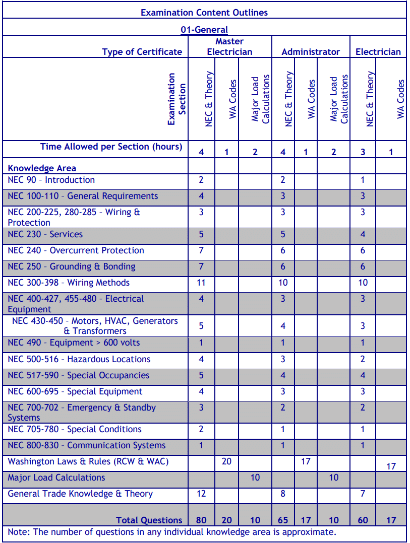
Testing requirements for EL01 General Electrical (01):
A Residential Electrician license is specialized in the telecommunications, low voltage, and line voltage wiring of one- and two-family dwellings. Additionally, it includes multifamily dwellings of types III, IV, or V construction with up to six stories, provided they are not above types I or II construction.
This certification covers all line voltage wiring required by the National Electrical Code (NFPA 70), primarily utilizing nonmetallic sheathed cables. However, exceptions exist for certain situations such as wiring subject to physical damage, embedded in masonry or concrete, or located in wet areas. Moreover, it encompasses wiring for ancillary structures on the same property, such as appliances, swimming pools, limited energy systems, and site lighting.
Excluded from this specialty are wiring tasks related to commercial occupancies, services, generators, HVAC/refrigeration equipment, and interconnected electric power production sources not serving residential dwellings. The scope also excludes wiring for conveyances serving more than one residential dwelling unit.
Overall, a Residential Electrician certification qualifies individuals to perform a comprehensive range of wiring tasks specific to residential properties, ensuring compliance with regulatory standards and safety protocols.
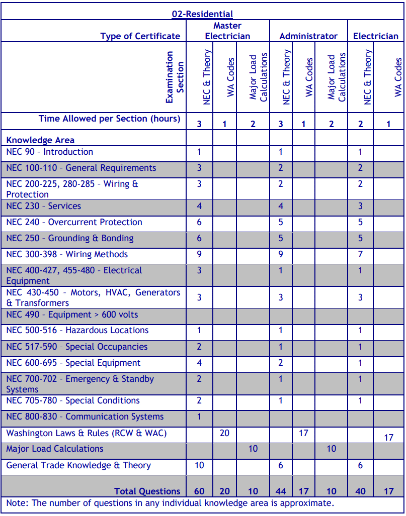
Testing requirements for EL02 Residential (02):
A Pump and Irrigation Electrician certification specializes in the electrical connection of circuits, feeders, controls, and low-voltage systems related to a water supply. This includes domestic water systems, public water systems, and irrigation systems.
Professionals with this certification are qualified to work on various components of water supply systems, such as pumps, pressurization equipment, filtration systems, treatment mechanisms, and associated controls. Additionally, they handle the electrical aspects of irrigation water pumps, circular irrigation system pumps, and pump houses.
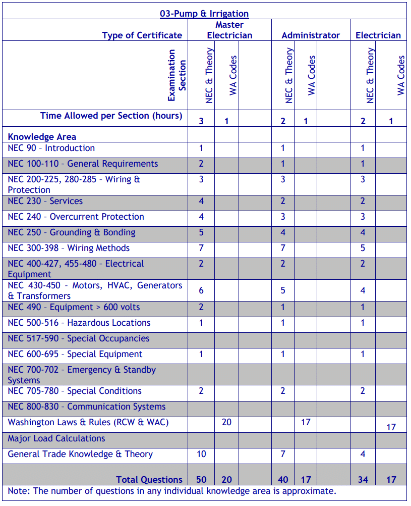
Testing requirements for EL03 Pump and Irrigation (03):
The Domestic Pump Electrician certification is tailored for tasks involving the extension of branch circuits to signaling circuits, motor control circuits, and motor control devices. This specialty is specifically designated for pumps not exceeding 7 1/2 horsepower at 250 volts AC single-phase input power, irrespective of motor controller output or motor voltage/phase.
Professionals with this certification primarily work on pumps utilized in residential potable water or residential sewage disposal systems. This includes various components of domestic water systems and public water systems, such as pumps, pressurization equipment, filtration systems, treatment mechanisms, and related controls.
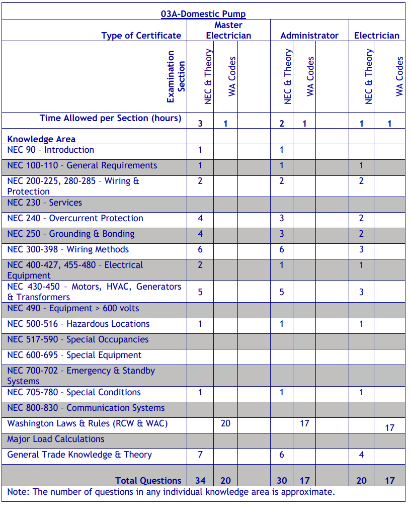
Testing requirements for EL03A Domestic Pump (03A):
The Signs Electrician certification is specialized in the placement and connection of signs and outline lighting, along with the electrical supply, related telecommunications, controls, and associated circuit extensions. Additionally, professionals with this certification are qualified to install a maximum 60 ampere, 120/240-volt single-phase service to supply power to a remote sign exclusively.
This specialty also encompasses the service, maintenance, repair, or installation of retrofit kits within housings of existing exterior luminaires mounted on poles or other structures, utilizing like-in-kind or retrofit kit components.
It’s important to note that while certain tasks related to electric signs do not require electrical licensing or certification, such as cleaning non-electrical parts or assembling structural parts of a billboard, specific electrical work such as installing, modifying, or maintaining electric signs or their components does require proper certification.
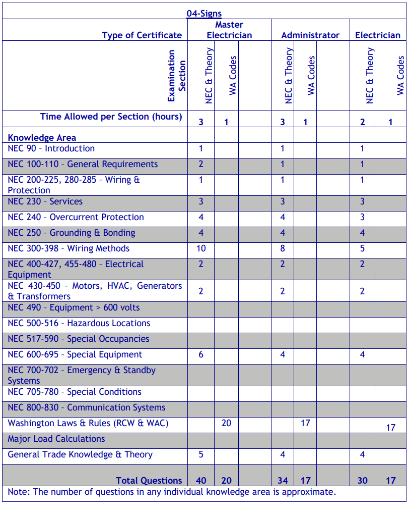
Testing requirements for EL04 Signs (04):
The Limited Energy System Electrician certification focuses on the installation, repair, replacement, and maintenance of signaling and power-limited circuits, specifically within low-voltage systems. This specialty covers a diverse range of applications, including telecommunications, HVAC/refrigeration low-voltage wiring, fire protection signaling systems, intrusion alarms, energy management and control systems, industrial and automation control systems, lighting control systems, and commercial and residential amplified sound.
Professionals with this certification are trained to work on various low-energy circuits and equipment across different occupancies and locations, ensuring their safe and efficient operation.
It’s important to note that when replacing components within control cabinets, replacements must be like-in-kind or replaced using the equipment manufacturer’s authorized replacement component. Line voltage connections are limited to 120 volts, 20 amps maximum, and must have a means of disconnect.
Limited Energy System Electricians may perform telecommunications work under their specialty license and administrator’s certificate.
For HVAC/refrigeration system specialties, specific definitions and guidelines can be found in WAC 296-46B-100. When replacing components within HVAC/refrigeration systems, replacements must also be like-in-kind or made using the equipment manufacturer’s authorized replacement component.
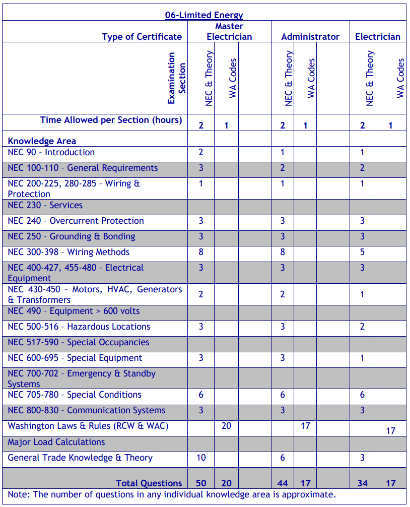
Testing requirements for EL06 Limited Energy System (06):
The HVAC/Refrigeration Electrician certification, denoted as (06A), encompasses a broad range of tasks related to HVAC and refrigeration systems, without limitations on voltage, phase, or amperage. This specialty covers installations, repairs, replacements, and maintenance of various components within HVAC and refrigeration systems.
Professionals with this certification are qualified to work on telecommunications, Class 2 low-voltage control circuit wiring, and components in both residential and non-residential occupancies. This includes installation, repair, replacement, and maintenance of line voltage components within HVAC/refrigeration equipment, such as product illumination luminaires and factory-authorized accessories.
Additionally, the scope of work for (06A) Electricians includes repairing, replacing, or maintaining internal components of HVAC/refrigeration equipment disconnecting means or controllers, as well as short sections of the raceway for cable protection and line voltage flexible supply whips.
It’s important to note that certain tasks are excluded from the scope of this specialty, such as installing line voltage controllers or disconnect switches external to HVAC/refrigeration equipment and working on integrated building control systems other than HVAC/refrigeration systems.
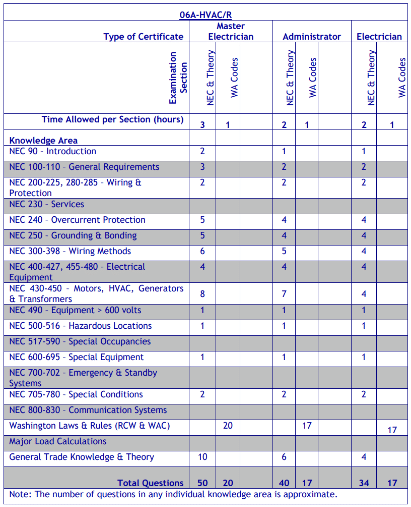
Testing requirements for EL06A HVAC/Refrigeration (06A):
The HVAC/Refrigeration – Restricted Electrician certification, denoted as (06B), is specialized in performing electrical work within HVAC and refrigeration systems with certain voltage and amperage limitations. This specialty is not authorized to perform any electrical work where the primary electrical power connection to the HVAC/refrigeration system exceeds 250 volts single-phase or 120 amps, or any work outlined in subsection (f)(iv)(B).
Professionals with this certification may install, repair, replace, and maintain telecommunications Class 2 low-voltage control circuit wiring/components in residential occupancies. They can also work on similar components in other occupancies with no more than three stories on/above grade. Additionally, (06B) Electricians are qualified to install, repair, replace, and maintain line voltage components within HVAC/refrigeration equipment, such as product illumination luminaires and factory-authorized accessories.
Tasks such as repairing, replacing, or maintaining internal components of HVAC/refrigeration equipment disconnecting means or controllers are also within the scope of this specialty. Furthermore, (06B) Electricians may work on short sections of the raceway for cable protection and line voltage flexible supply whips.
However, certain tasks are excluded from the scope of this specialty, such as installing line voltage controllers or disconnect switches external to HVAC/refrigeration equipment, working on integrated building control systems other than HVAC/refrigeration systems, and installing, repairing, or replacing line voltage equipment or components not exclusively controlled by the HVAC/refrigeration system.
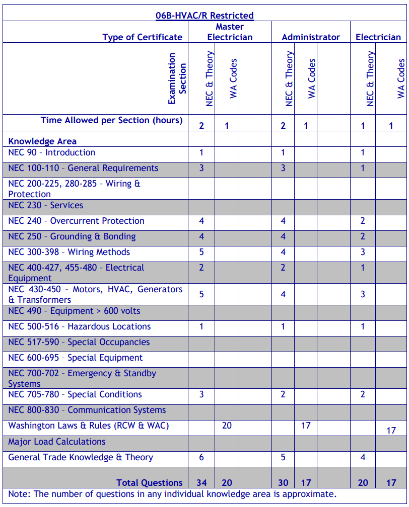
Testing requirements for EL06B HVAC/Refrigeration – Restricted (06B):
The Nonresidential Maintenance Electrician certification, designated as (07), specializes in the maintenance, repair, and replacement of existing electrical equipment and conductors within nonresidential settings. This specialty focuses on ensuring the continued functionality and safety of electrical systems in commercial and industrial environments.
Professionals with this certification are authorized to perform maintenance activities limited to like-in-kind replacements of existing electrical equipment and conductors. This includes tasks such as replacing devices providing overcurrent or overload protection, provided the new equipment has a lower ampere rating and there are no modifications to the ampacity rating of the existing conductors.
Additionally, (07) Electricians may install and connect temporary conductors and equipment for load testing purposes, not exceeding 600 volts.
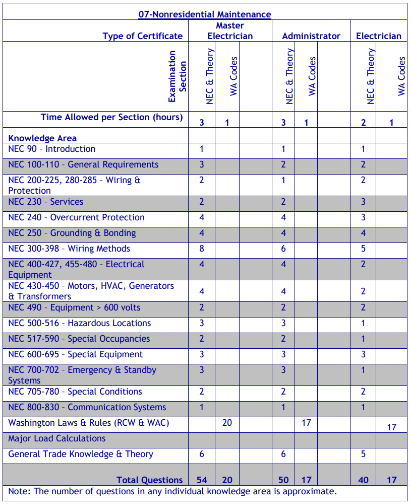
Testing requirements for EL07 Nonresidential Maintenance (07):
The Residential Maintenance Electrician certification, labeled as (07B), is specifically tailored for residential dwellings and certain multistory structures with residential units. This specialty is dedicated to maintaining, repairing, or replacing existing electrical utilization equipment within residential settings, adhering to regulatory standards and safety protocols.
Professionals with this certification are authorized to work on equipment and circuits up to a maximum of 250 volts, 60 amperes, and single phase. Tasks may include disconnecting and reconnecting low-voltage control and line voltage supply whips not exceeding six feet in length, provided there are no modifications to the characteristics of the branch circuit or whip.
It’s important to note that “electrical equipment” within the scope of this specialty excludes electrical conductors, raceway, or conduit systems external to the equipment or whip. Additionally, (07B) Electricians are not permitted to perform any plumbing work regulated under Chapter 18.106 RCW.
Testing requirements for EL07B Residential Maintenance (07B):
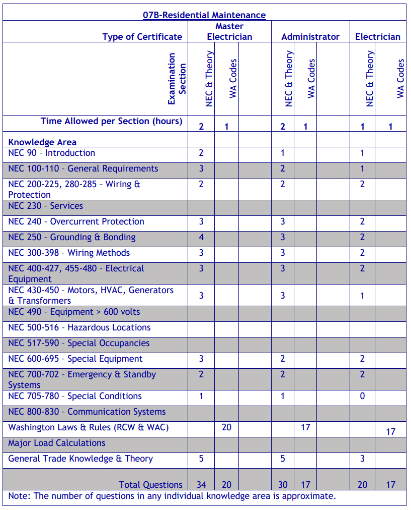
The Restricted Nonresidential Maintenance Electrician certification, identified as (07C), is tailored for maintaining, repairing, or replacing existing electrical utilization equipment within certain nonresidential settings, excluding specific tasks related to circuit breakers. This specialty focuses on ensuring the functionality and safety of electrical systems in commercial and industrial environments while adhering to regulatory standards and safety protocols.
Professionals with this certification are authorized to work on equipment and circuits within specified voltage and amperage limitations. Lighting branch circuits are limited to a maximum of 277 volts and 20 amperes, while other circuits are limited to a maximum of 250 volts and 60 amperes. Tasks may include disconnecting and reconnecting low-voltage control and line voltage supply whips not exceeding six feet in length, provided there are no modifications to the characteristics of the branch circuit.
In regards to luminaire replacement, (07C) Electricians are limited to in-place replacements necessitated by luminaire failure. In cases where luminaires are installed in suspended lay-in tile ceilings, relocation is permitted under certain conditions, ensuring compliance with safety standards.
It’s important to note that “electrical equipment” within the scope of this specialty excludes electrical conductors, raceway, or conduit systems external to the equipment or whip. Additionally, (07C) Electricians are restricted from performing tasks governed under specific articles of the NEC related to classified locations and any plumbing work regulated under Chapter 18.106 RCW.
Testing requirements for EL07C Restricted Nonresidential Maintenance (07C):
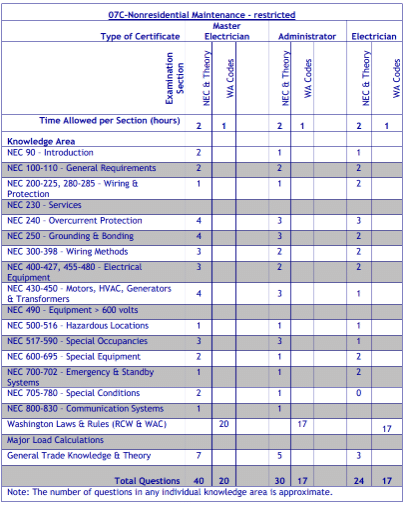
The Appliance Repair Electrician certification, denoted as (07D), specializes in servicing, maintaining, repairing, or replacing a variety of household appliances, small commercial/industrial appliances, and other small electrical utilization equipment. This specialty is crucial for ensuring the proper functionality and safety of various electrical appliances in both residential and commercial settings.
For clarification, appliances and electrical utilization equipment under this specialty must be self-contained and standardized in size or type, operating on a single source of electrical power limited to a maximum of 250 volts, 60 amperes, and single phase. Examples of appliances and equipment include ovens, office equipment, commercial kitchen equipment, hot tubs, and scales.
Tasks within this specialty include in-place like-in-kind replacements of appliances or equipment, including the replacement of electrical components within them. Additionally, professionals are authorized to disconnect and reconnect low-voltage control and line voltage supply whips, as well as install outlet boxes and outlets for appliances requiring a plug and cord connection.
It’s important to note that this specialty excludes tasks such as installation, repair, or modification of branch circuits, services, feeders, panelboards, disconnect switches, or raceway/conductor systems interconnecting multiple appliances or equipment. Additionally, work governed under specific NEC articles related to classified locations and any plumbing work regulated under chapter 18.106 RCW is not within the scope of (07D) Electricians.
Testing requirements for EL07D Appliance Repair (07D):
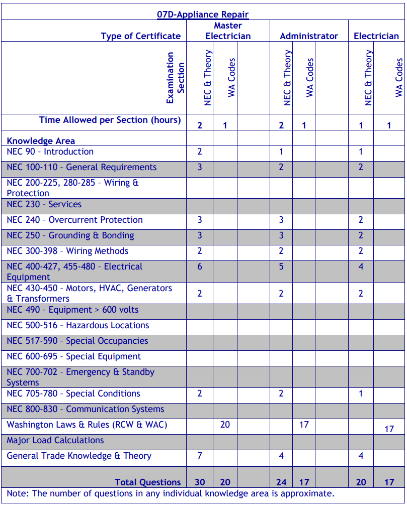
The Equipment Repair Electrician certification, identified as (07E), is dedicated to servicing, maintaining, repairing, or replacing various types of utilization equipment. This specialty encompasses a broad range of tasks related to ensuring the functionality and safety of equipment across different industries and settings.
For a detailed scope of work and definitions related to equipment repair, individuals are directed to refer to RCW 19.28.095. This regulation provides comprehensive guidelines and standards for professionals within the equipment repair specialty, outlining the specific tasks and responsibilities they are authorized to perform.
It’s important to note that while professionals with this certification are skilled in equipment repair, they are not authorized to perform any plumbing work regulated under Chapter 18.106 RCW. This limitation ensures adherence to relevant regulations and standards governing plumbing activities.
Testing requirements for EL07E Equipment Repair (07E):
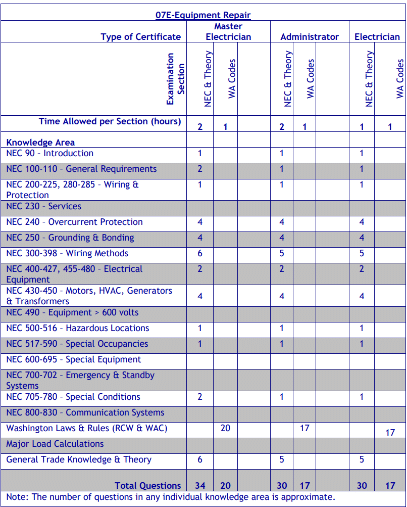
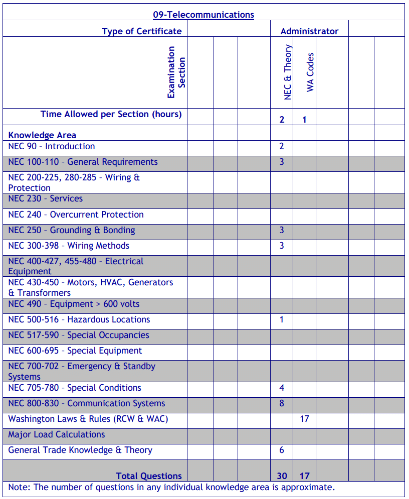
The Telecommunications Electrician certification, labeled as (09), focuses on the installation, maintenance, and testing of telecommunications systems, equipment, and associated hardware, ensuring efficient communication infrastructure across various settings.
This specialty encompasses a range of tasks, including the installation of telecommunications cables in open wiring systems, surface nonmetallic raceways dedicated to telecommunications, optical fiber inner-duct raceways, and underground raceways for system expansions within buildings. Additionally, professionals in this field handle the installation of cable management systems, such as cable trays and ladder racks, to organize telecommunications cabling effectively.
Tasks within this specialty also cover the installation of audio or paging systems integrated into telephone system equipment, as well as customer satellite and conventional antenna systems for receiving telecommunications signals. However, it’s essential to note that closed-circuit video monitoring systems are excluded from this specialty if they involve the integration of line or low-voltage controls for cameras and equipment, which fall under the domain of security systems requiring appropriate licensing.
Additionally, the Telecommunications (09) specialty does not include horizontal cabling for specific signal systems like fire protection, intrusion alarms, or access control systems. While telecommunications systems may interface with these systems at designated points, the installation or termination of premises line voltage service, feeder, or branch circuit conductors or equipment is not within the scope of this specialty.
Testing requirements for EL09 Telecommunications (09):
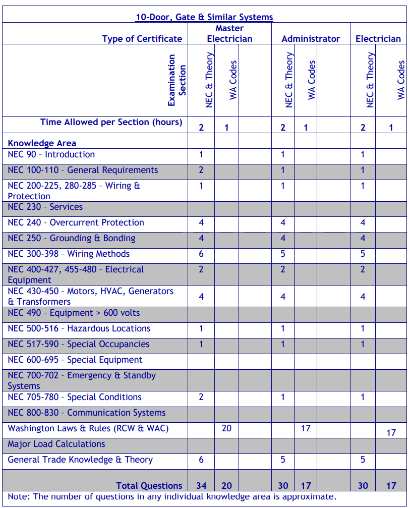
The Door, Gate, and Similar Systems Electrician certification, designated as (10), specializes in the installation, servicing, maintenance, repair, and replacement of electrical wiring and equipment associated with door, gate, and similar systems.
This specialty encompasses a wide range of electrical components and systems, including electric gates, doors, windows, awnings, movable partitions, curtains, and similar mechanisms. Professionals in this field handle various system elements such as electric operators, control push buttons, key switches, keypads, sensors, detectors, timers, and control panels, ensuring their proper functioning and integration.
Tasks within this specialty include the installation of low-voltage (NEC Class 2) electrical systems specific to door, gate, and similar mechanisms, provided they are standalone systems not interconnected with other systems. Additionally, professionals may work on branch circuits originating from listed door/gate/similar systems electric operator control panels, ensuring compliance with voltage and amperage limitations.
However, it’s important to note that this specialty excludes work governed under specific NEC articles related to classified locations. Professionals with the Door, Gate, and Similar Systems (10) certification are not authorized to install, repair, or replace branch circuit conductors, services, feeders, panelboards, or disconnect switches supplying the door/gate/similar systems electric operator control panel.
Testing requirements for EL10 Door, Gate, and Similar Systems (10):